


Cooper for Copper (C4Cu) a Manifesto: Why Copper Is Here to Stay...
Cooper for Copper (C4CU) Manifesto: Why Copper Is Here to Stay Copper isn’t a trend. Copper isn’t a trade. Copper is infrastructure. And infrastructure doesn’t disappear. At C4CU (Copper for Copper / Cooper 4 Copper), we operate on a simple premise: the world is electrifying, digitising, and scaling at a pace that most investors still don’t fully understand and copper sits at the centre of it all.
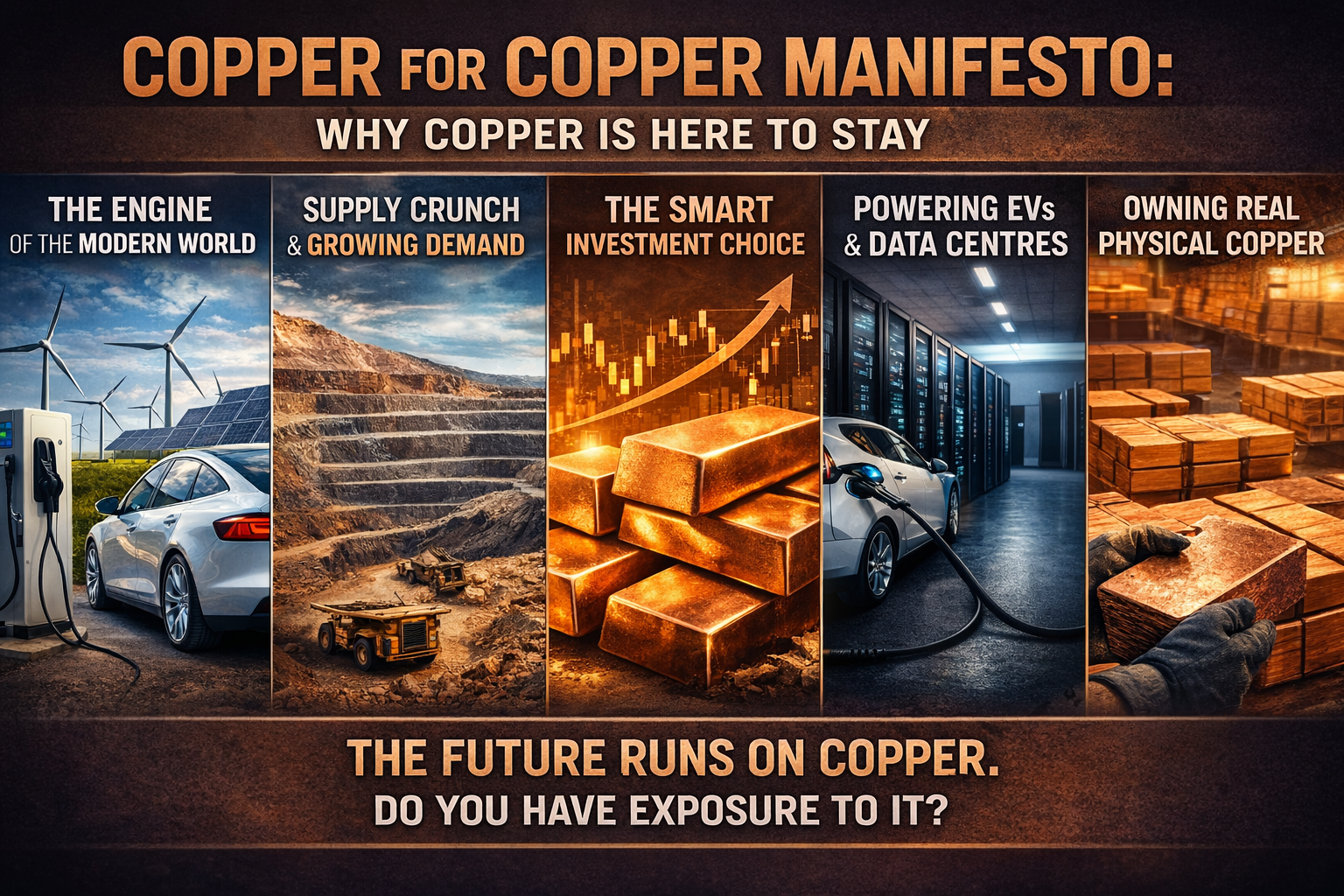
A Manifesto: Why Copper Is Here to Stay
Copper isn't a trend. It isn't a trade. It is infrastructure. And infrastructure doesn't disappear.
The World Is Electrifying. Copper Is the Wire.
The world is electrifying, digitising, and scaling at a pace most investors still don't fully understand. Electric vehicles, renewable energy systems, AI data centres, smart power grids, industrial manufacturing: every one of these systems runs on copper. Not metaphorically. Physically. The metal that carries the current.
This is not a narrative built on speculation. It is built on engineering. Every wind turbine, every solar array, every EV charging network, every fibre-connected server farm requires copper at its core. The question is not whether copper will be needed. The question is whether there will be enough of it.
"A single electric vehicle uses up to 4x more copper than a traditional combustion engine car. Multiply that by the tens of millions of EVs coming to market each year."
— C4CU Research Team, 2026
That single statistic tells the demand story clearly. But EVs are only one driver. One AI data centre requires as much copper as 30,000 homes (C4CU Research, 2026). An offshore wind turbine contains 8 to 15 tonnes of copper. A solar farm uses 5x more copper per megawatt than a gas plant. These are not marginal changes. This is structural demand, underpinned by government net-zero commitments and the physical laws of electricity.
The Supply Reality: Why Copper Is Different
Demand is rising. Supply is constrained. This is not a temporary imbalance caused by shipping delays or short-term market sentiment. It is structural, and it stems from one inconvenient fact: it takes 15 to 20 years to bring a new copper mine from discovery to production.
The pipeline of new projects is thin. Existing mines are aging. Average ore grades have declined approximately 25% over the past two decades (S&P Global, 2024), meaning miners must process more rock to produce the same amount of metal. Chile and Peru, which together account for roughly 40% of global copper supply, face compounding challenges: water scarcity, community opposition, and increasingly complex permitting requirements that can add five to seven years to new projects.
Global copper demand currently runs at approximately 26 million tonnes per year. Mine supply delivers around 22 million tonnes. The IEA projects total demand to double by 2035. No credible forecast closes that gap without significant price signals and a decade-long investment cycle that has not yet fully begun (IEA World Energy Outlook, 2024).
Copper is not a commodity that can be substituted away. Aluminium carries current at lower cost but requires more of it and handles heat poorly. Silver conducts better but costs forty times more. In critical applications, copper remains the default. The world is not moving away from copper. It is moving deeper into it.
From Industrial Metal to Asset Class
For decades, copper was an industrial input. Something purchased by manufacturers and tracked by economists as a barometer of global growth. The question sophisticated investors are now asking has shifted: not "which company will benefit from copper demand?" but "how do I get direct exposure to copper itself?"
That shift matters. Copper sits at the intersection of four of the most powerful long-run macro themes of our era: inflation protection through tangible assets, the infrastructure supercycle driven by electrification, the energy transition away from fossil fuels, and the digital economy's insatiable appetite for data processing power. Each of these themes, on its own, would be a credible reason to consider copper. Together, they form a compelling structural case.
The Problem: Most People Don't Actually Own Copper
Here is where most investors hit a wall. Believing they have copper exposure through a mining stock or commodity ETF is understandable. It is also, in most cases, incorrect.
Owning shares in a mining company is not the same as owning copper. You own equity in a business with its own management decisions, capital allocation risks, labour disputes, and jurisdiction exposures. The copper price goes up 20%; the mining company might not move at all, or it might go down.
Copper ETFs introduce a different set of problems. Most do not hold physical copper. They hold futures contracts, which roll at a cost. In a contango market, that roll cost can erode 5 to 15% of value per year (C4CU Research, 2026). There is also counterparty risk baked in: the instrument depends on a financial institution's promises, not on a bar of metal sitting in a warehouse with your name on it.
"Owning shares in a mining company is not the same as owning copper. Owning a copper ETF is not the same as owning copper. Only owning copper is owning copper."
— C4CU Manifesto, 2026
In 2022, LME warehouse stocks plunged 80% in a matter of months, exposing the widening gap between paper claims and physical supply. The LME nickel crisis that same year provided an even starker lesson: when paper positions massively exceed physical inventory, markets can break in ways that retail holders pay for.
The C4CU Model: Direct Ownership, No Abstraction
C4CU was built on a single premise: give investors direct access to allocated, LME Grade A physical copper. No leverage. No derivatives. No abstraction. Just copper.
The institutional standard for copper is the LME Grade A cathode: 99.99% pure, the global benchmark for trade and settlement. Historically, accessing this market required a minimum of 25 metric tonnes on the London Metal Exchange, representing over £225,000 at current prices. C4CU removes that barrier, making allocated ownership accessible from 10 kg.
Allocated ownership means your copper is held in your name, in a professional insured facility, and is never pooled, lent out, or rehypothecated. It is not a claim on copper. It is copper. There is a difference, and it matters when markets come under stress.
The fee structure is deliberately simple: one 5% all-inclusive fee that covers sourcing, storage, insurance, allocation, and management. Nothing hidden. Nothing deferred. The founder team brings over 50 years of combined copper trading experience from institutional markets, applied to a platform that anyone can use.
Why Copper Matters in the UK and Globally
The UK context is particularly clear. National Grid upgrades to support renewable energy and EV charging infrastructure are underway. The government's EV adoption targets require a charging network that does not yet exist at scale. Every part of that buildout is copper-intensive.
Globally, the picture is the same, only larger. The United States is deploying trillions in infrastructure and clean energy investment. Europe is accelerating its green transition under increasingly aggressive policy frameworks. China remains the world's largest copper consumer, representing over 50% of global demand, and is building out domestic EV, grid, and manufacturing capacity at a pace with no historical precedent. Emerging markets across Asia, Africa, and Latin America are laying the foundations of electrified transport and energy systems that simply did not exist a generation ago.
Copper does not shout. It does not generate headlines or trend on social media. It moves everything quietly, embedded in the systems that power the electrification of transport, the digital economy, and the energy transition. That quietness is precisely why most investors are underexposed to it.
The Final Thought
The structural case for copper is not difficult to make. The demand drivers are real, measurable, and accelerating. The supply constraints are geological and regulatory, and they will not resolve quickly. The gap between where global copper supply stands today and where global copper demand is heading by 2035 is one of the most significant commodity stories of this decade.
Access to the physical metal, allocated to your name, at LME Grade A standard, was until recently the exclusive preserve of institutions. That has changed.
Do you have exposure to it? If not, why not?
Frequently Asked Questions
Why is copper demand expected to grow so much?
Copper is the primary conductor in every major electrification technology. A single EV requires up to 83 kg of copper, roughly 4x the amount in a combustion engine car. One AI data centre uses the copper equivalent of 30,000 homes. An offshore wind turbine contains 8 to 15 tonnes of copper. Solar farms use 5x more copper per megawatt than gas plants. The IEA projects global copper demand to double by 2035, driven by EV adoption, grid upgrades, renewable energy buildout, and digital infrastructure expansion (IEA World Energy Outlook, 2024). These are not cyclical trends. They are structural shifts underpinned by government policy, engineering requirements, and capital commitments already in motion.
Why can't supply just increase to meet demand?
Copper supply cannot respond quickly to rising demand because developing a new mine takes 15 to 20 years from discovery to first production. The pipeline of new projects is thin, existing mines are aging, and average ore grades have fallen approximately 25% over the past 20 years (S&P Global, 2024), meaning more rock must be processed to yield the same output. Chile and Peru, which supply around 40% of the world's copper, face water scarcity, permitting delays, and social licence challenges that can add years to new projects. There is no short-term fix. The structural deficit between supply and demand is expected to persist and widen through the 2030s.
What is the difference between a copper ETF and owning physical copper?
Most copper ETFs do not hold physical copper. They hold futures contracts, which must be rolled forward at regular intervals. In a contango market (where future prices are higher than spot), this rolling process erodes value, sometimes by 5 to 15% per year. ETFs also carry counterparty risk: you hold a financial instrument backed by a bank or fund provider's promise, not by a bar of metal held in your name. In contrast, owning allocated physical copper means your specific metal is segregated, insured, held in a professional storage facility, and never lent out or pooled with others. The 2022 LME nickel crisis illustrated clearly what can happen when paper claims on a commodity massively exceed physical supply.
What is LME Grade A copper and why does it matter?
LME Grade A copper cathode is the global benchmark for copper quality and trade, refined to 99.99% purity through an electrolytic process. It is the format that institutions, manufacturers, and governments buy and sell through the London Metal Exchange. Holding LME Grade A material means owning the most liquid, universally recognised form of physical copper: the same standard used in global settlement. Not all copper products meet this specification. Lower grades may carry discounts, be harder to sell, or be rejected by buyers. When C4CU offers LME Grade A cathodes, it means customers own copper at the highest tradeable standard, exactly as institutions do.
How does C4CU work and what does it cost?
C4CU operates as a principal-to-principal physical copper seller. The process is straightforward: register on the platform, view live LME-linked pricing, purchase a minimum of 10 kg of LME Grade A copper cathode, and your copper is allocated to you by name in professional insured storage. You can sell back through the platform when you choose. The cost is a single 5% all-inclusive fee that covers sourcing, storage, insurance, allocation, and ongoing management. There are no hidden charges, no rolling costs, and no annual fees beyond that initial 5%. The minimum entry point of 10 kg makes allocated ownership accessible from approximately £1,000 at current prices, compared to a traditional LME minimum of 25 metric tonnes.
Is physical copper a good hedge against inflation?
Physical commodities have historically provided a degree of protection against inflation because their value is anchored to real-world supply and demand rather than to monetary policy or financial instrument pricing. Copper in particular benefits from the dual dynamic of rising input costs (energy, labour, water) driving producer prices higher, and structural demand growth from electrification that creates a persistent bid beneath the market. Copper has outperformed gold over the past 20 years on a percentage basis (LME historical data). However, the price of copper is volatile and can go down as well as up. Past performance is not an indicator of future results. Physical copper should be considered as part of a broader portfolio, not as a standalone inflation solution. C4CU does not provide financial advice.
Ready to Own Physical Copper?
Start with as little as 10 kg of LME Grade A copper cathode — stored, insured, and allocated in your name.
Start Owning Copper →
Get Copper Market Updates
Join investors receiving insights on copper prices, market trends, and opportunities. Free, no spam.
By subscribing, you agree to our Privacy Policy.
Ready to Own Real Copper?
Start owning physical copper today. Simple, transparent, accessible.