


Copper as a Currency Hedge: Why Investors in Weak-Currency Countries Are Looking at Industrial Metals
Copper is increasingly viewed as a potential hedge against inflation and currency devaluation in countries experiencing weak or unstable currencies. Because copper is priced globally and driven by real industrial demand from electrification, infrastructure, electric vehicles, and data centres, it can offer diversification away from domestic monetary instability. As global demand for copper continues to grow while supply remains constrained, physical copper ownership is gaining attention as a long-term hard asset within diversified portfolios.
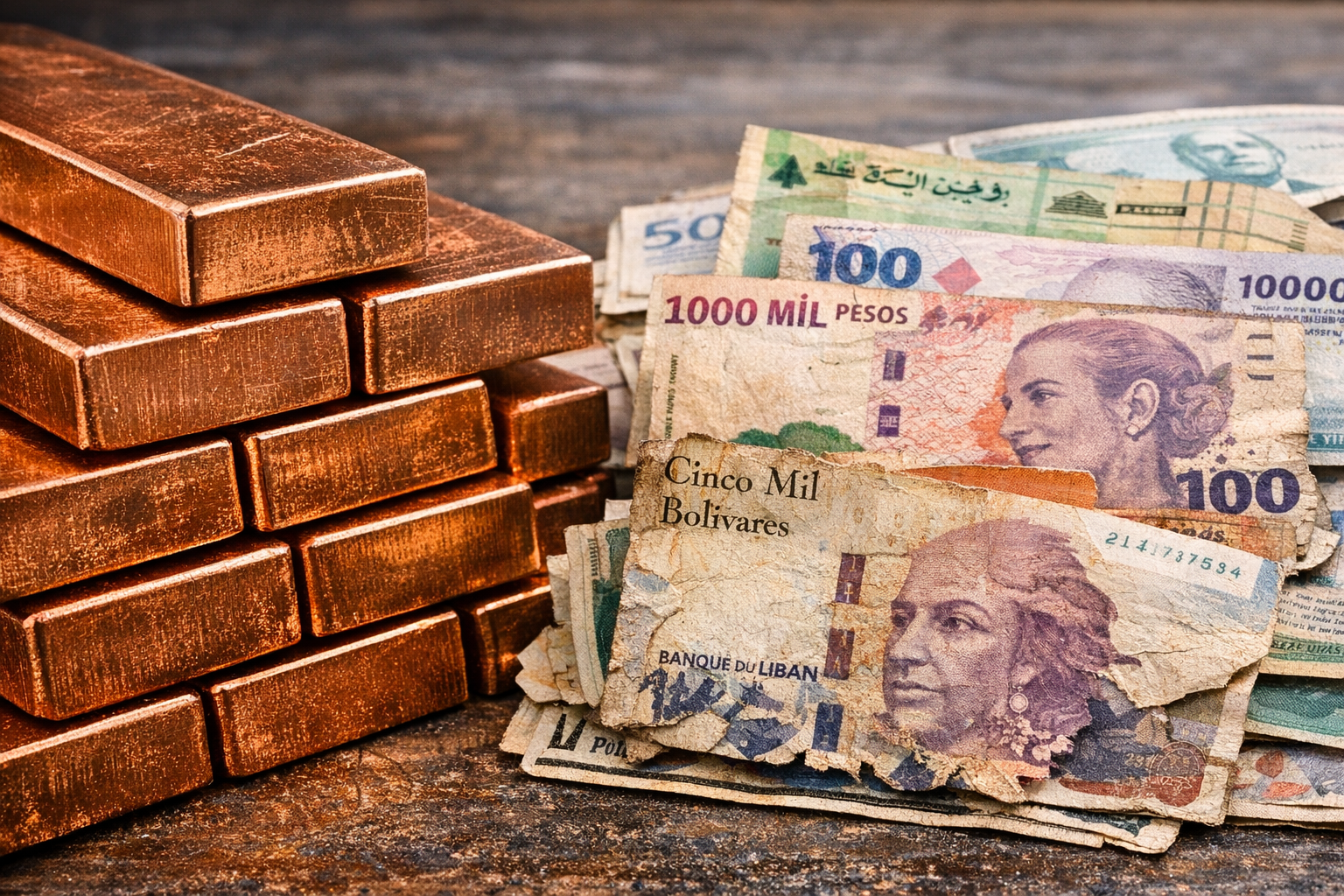
Copper as a Currency Hedge: Why Investors in Weak-Currency Countries Are Looking at Industrial Metals
When your currency loses half its value overnight, globally traded physical metal looks very different from a savings account.
Currency Instability Is Not Theoretical for Millions of People
For investors in the UK, US, or Western Europe, currency devaluation is an economic concept discussed in textbooks. For tens of millions of people in Lebanon, Argentina, Turkey, Nigeria, and Venezuela, it is a lived reality that wipes out savings within months. When a currency loses 30 to 50 per cent of its value, the question is not whether to protect purchasing power. The question is how.
Historically, people in these situations turned to gold, US dollars, foreign real estate, or any asset priced internationally rather than domestically. Now copper is entering that conversation, and the reasons are worth understanding whether you live in a weak-currency country or not.
Why Devaluation Drives Demand for Hard Assets
When a domestic currency weakens, every asset priced in that currency loses value relative to the rest of the world. A bank deposit denominated in Lebanese pounds, Argentine pesos, or Turkish lira does not hold its value in real terms. The savings are still there numerically, but their purchasing power collapses.
The response is rational: move capital into assets priced globally rather than locally. The classic options have always been:
- Holding US dollars or euros
- Buying gold and precious metals
- Purchasing foreign real estate
- Holding globally traded commodities
Copper belongs in that final category. Because copper trades through major exchanges, including the London Metal Exchange (LME), its value is determined by global supply and demand rather than the monetary policy of any single country. An investor in Ankara holding physical copper is not exposed to Turkish central bank decisions in the same way an investor holding Turkish lira assets is.
"Copper's value is determined by global supply and demand, not the monetary policy of any single country. That distinction matters enormously when your currency is in freefall."
C4CU analysis
Eight Countries Where Currency Weakness Has Changed the Calculation
These are not hypothetical scenarios. The following countries have each experienced severe or sustained currency deterioration in recent years, driving citizens toward internationally priced hard assets.
| Country | Currency | Key Trigger |
|---|---|---|
| Lebanon | Lebanese Pound (LBP) | Banking crisis, sovereign debt default, hyperinflation from 2019 |
| Argentina | Argentine Peso (ARS) | Repeated inflation crises and peso depreciation across multiple decades |
| Turkey | Turkish Lira (TRY) | Surging inflation and sustained lira depreciation in recent years |
| Nigeria | Nigerian Naira (NGN) | Repeated currency adjustments and restricted access to US dollars |
| Egypt | Egyptian Pound (EGP) | Multiple devaluations and declining purchasing power in recent years |
| Pakistan | Pakistani Rupee (PKR) | Sustained depreciation driven by inflation and external debt pressures |
| Venezuela | Venezuelan Bolivar (VES) | One of the most extreme hyperinflation cases in modern history |
| Zimbabwe | Zimbabwe Dollar (ZWL) | Multiple currency collapses over two decades driving demand for hard assets |
In each case, citizens and investors who could access internationally priced assets were better positioned to preserve the real value of their wealth.
Why Copper Is Different From Gold
Gold is the traditional monetary hedge. Central banks hold it. It has no industrial function beyond jewellery and electronics. Its value rests almost entirely on its role as a store of wealth and financial safe haven. That is a legitimate use case, but it means gold's value is driven primarily by financial sentiment rather than physical demand.
Copper is different. Copper is a strategic industrial metal, and its value is underpinned by real economic demand. It is used extensively in:
- Electrical grids and power transmission
- Renewable energy systems (solar, wind, battery storage)
- Electric vehicles
- AI data centres and computing infrastructure
- Telecommunications networks
- Construction and manufacturing
This means that even without financial-market sentiment, copper has a structural demand floor rooted in the physical economy. For a currency-conscious holder, that provides a different kind of reassurance than a purely financial asset.
Gold's value is primarily financial. Copper's value is industrial. Both are priced globally and outside any single country's monetary control, but copper carries structural demand from electrification, EV manufacturing, and data centre growth. That demand does not disappear when financial markets shift sentiment.
The Structural Demand Drivers Behind Copper's Long-Term Value
Four major global trends are pushing copper demand higher over the next two decades:
Electrification. Copper is the most efficient electrical conductor available at scale. As countries expand and modernise electricity infrastructure, copper demand increases in direct proportion. This applies globally, including in the same emerging market economies where currency instability is most acute.
Renewable energy. Solar installations, wind turbines, and battery storage systems require substantial copper. The energy transition is, in a very direct sense, a copper story.
Electric vehicles. An electric vehicle requires significantly more copper than a conventional combustion engine vehicle. As EV adoption scales globally, copper demand scales with it.
AI and data centres. Large-scale computing infrastructure requires vast electrical networks and extensive copper wiring throughout. The AI buildout is accelerating copper demand in ways that were not forecast even five years ago.
On the supply side, the picture is constrained. New copper mines require 15 to 20 years to develop from discovery to production. Supply cannot respond quickly to rising demand. That structural imbalance supports copper's long-term value in global pricing terms, which is precisely what matters for an investor trying to hold value outside a depreciating domestic currency.
"New copper mines take 15 to 20 years to develop. Supply cannot keep pace with the electrification wave. That structural gap is what makes copper's global price floor credible over the long term."
Industry consensus, referenced across Wood Mackenzie and S&P Global Commodity Insights reports
Copper Is Priced Globally: What That Means in Practice
The LME and COMEX set global copper prices based on worldwide supply and demand. A kilogram of LME Grade A copper cathode is worth the same whether it is stored in a warehouse in Rotterdam or one in Singapore. The price is not set by any single country's central bank, government, or monetary policy.
For an investor in a weak-currency country, this matters enormously. If they hold physical copper and their domestic currency loses 40 per cent of its value, the copper has not lost 40 per cent of its purchasing power. Its LME price in US dollars remains anchored to global fundamentals. When they eventually sell the copper, they receive a price linked to the global market, not to the domestic monetary situation.
This does not mean copper is risk-free. The price of copper is volatile and can go down as well as up, and past performance is not an indicator of future results. But the source of that volatility is global economic conditions, not a single country's currency mismanagement. That is a meaningful distinction for a diversification strategy.
How Physical Copper Ownership Actually Works
Institutional copper trading has historically occurred through warehouse warrants: documents representing ownership of a specific quantity of metal stored in an LME-approved warehouse. A standard contract typically represents around 25 metric tons, which put direct physical ownership well beyond the reach of most private individuals.
That barrier is changing. Platforms are now making LME Grade A copper ownership accessible in smaller allocations, starting at 10 kg, with allocated ownership, professional storage, and full insurance. The copper is real, it is assigned to a specific owner, and it is not rehypothecated or pooled with other clients' holdings.
This is different from a copper ETF or a futures contract. Those instruments give financial exposure to copper's price, but the holder does not own any physical metal. If the ETF provider or counterparty encounters problems, the paper exposure may not translate into real copper. Physical ownership removes that counterparty layer entirely.
Allocated ownership means a specific quantity of physical copper is registered in your name in a specific warehouse. You own identifiable metal. Unallocated means you have a claim against a pool of metal held by someone else. In a crisis, those are very different positions. C4CU facilitates allocated, principal-to-principal transactions in LME Grade A copper cathodes.
The Bigger Picture: Hard Assets in a World of Monetary Uncertainty
Currency instability has historically pushed investors toward assets that maintain value across borders. This dynamic is not new. What is new is the range of globally traded hard assets now accessible to private individuals at smaller allocations and with genuine physical ownership rather than paper derivatives.
Copper's case is particularly interesting because it sits at the intersection of two powerful trends: the macro case for hard assets as a currency hedge, and the structural demand case from electrification, EVs, renewable energy, and AI infrastructure. Investors examining copper through either lens arrive at the same conclusion: this is a metal with long-term global relevance.
For anyone in a weak-currency environment, or anyone seeking diversification from domestic monetary risk, copper as a globally priced, physically owned, industrially essential metal is a serious conversation worth having.
Frequently Asked Questions
Q: Is physical copper a good hedge against currency devaluation?
Physical copper trades on the London Metal Exchange at a globally determined price, meaning its value is not tied to any single country's monetary policy. When a domestic currency loses value, copper held in an internationally priced market does not automatically lose purchasing power alongside it. Countries experiencing severe currency collapse, including Lebanon (from 2019), Argentina, and Venezuela, have seen citizens move capital into internationally priced commodities precisely for this reason. That said, copper prices are volatile and can go down as well as up. It is a diversification tool, not a guaranteed store of value.
Q: How does copper compare to gold as an inflation hedge?
Gold is a monetary metal held by central banks worldwide, with value driven primarily by financial sentiment and safe-haven demand. Copper is a strategic industrial metal with value underpinned by real physical demand: electric vehicles require significantly more copper than combustion vehicles, solar and wind installations require large copper quantities, and AI data centres require extensive copper wiring. New copper mines take 15 to 20 years to develop, meaning supply is structurally constrained against rising demand. Both metals offer global pricing outside domestic monetary policy, but copper's demand floor comes from the physical economy rather than financial markets alone.
Q: What are the risks of holding physical copper as a currency hedge?
Copper prices are volatile and can fall significantly during global economic slowdowns when industrial demand contracts. Unlike gold, copper's price is more sensitive to global growth cycles because it is tied to industrial activity. Storage and insurance costs also apply if holding physical metal. Additionally, liquidity, while generally good at the institutional level via the LME, may be slower than liquid financial assets for private holders. Past performance is not an indicator of future results. Copper is best considered as one component of a diversified approach to preserving purchasing power, not a standalone solution.
Q: Why do investors in countries like Argentina and Turkey buy commodities when their currency weakens?
When a domestic currency depreciates rapidly, savings held in that currency lose real purchasing power regardless of nominal account balances. Assets priced in global markets, including commodities traded on the LME or COMEX, retain value relative to international purchasing power rather than domestic monetary conditions. Argentina has experienced multiple peso devaluations, with the currency losing substantial value against the US dollar over recent decades. Turkish lira holders have faced similar pressures as inflation surged. In both cases, citizens with access to globally priced assets, whether dollars, gold, or commodities, were better protected against domestic monetary erosion.
Q: What is the difference between owning physical copper and a copper ETF?
A copper ETF provides financial exposure to copper's price but does not give the holder ownership of any physical metal. The holder has a claim against a fund or financial product, introducing counterparty risk: if the fund provider encounters difficulties, the paper exposure may not translate into real metal. Physical copper ownership means a specific quantity of LME Grade A copper cathode is registered in the owner's name at an approved warehouse. There is no intermediate counterparty between the owner and the metal. For a currency hedge, the distinction matters: physical ownership removes the financial intermediary layer that also carries its own risks.
Q: How can I own physical copper without storing it myself or buying 25 tonnes at once?
Historically, direct physical copper ownership was only accessible at institutional scale, with standard LME contracts representing around 25 metric tons. Platforms such as C4CU now facilitate allocated ownership of LME Grade A copper cathodes starting from 10 kg, with the metal held in professionally managed, insured warehouses. The copper is allocated specifically to the buyer's name, not pooled with other holdings. Storage and insurance are included in a single transparent fee, removing the need for the owner to arrange their own logistics or custody. C4CU is operated by A42C Ltd and facilitates principal-to-principal transactions only, not financial products or investment services.
Ready to Own Physical Copper?
Start with as little as 10 kg of LME Grade A copper cathode, stored, insured, and allocated in your name.
Start Owning Copper →
Get Copper Market Updates
Join investors receiving insights on copper prices, market trends, and opportunities. Free, no spam.
By subscribing, you agree to our Privacy Policy.
Ready to Own Real Copper?
Start owning physical copper today. Simple, transparent, accessible.