


How the Physical Copper Market Works: LME, Warehouses, and Warrants Explained
The physical copper market operates through global systems such as the London Metal Exchange (LME), warehouse storage, and warrants representing ownership of real metal. Unlike ETFs or stocks, copper is traded and settled as a physical commodity, with institutional-sized contracts typically around 25 metric tons. Understanding this structure highlights how copper is priced globally and why access to physical copper investment has historically been limited but is now becoming more accessible.
How the Physical Copper Market Works: LME, Warehouses, and Warrants Explained
Most investors think they understand copper. The physical market works nothing like they imagine.
Copper Is Not Traded Like a Stock
Most investors assume the copper market works roughly the same way equities do: a price appears on a screen, someone clicks buy, and ownership transfers. That assumption misses almost everything that matters about how copper actually moves through the global economy.
The global copper market is built on a physical infrastructure of warehouses, warehouse warrants, and contracts, with the London Metal Exchange (LME) sitting at the centre. Understanding that infrastructure is essential for anyone exploring copper as a long-term asset, a hedge against inflation, or an alternative to paper-based commodity exposure.
This article explains how it all fits together: what the LME does, what a copper warrant actually is, where the metal is stored, and why retail access to this market has historically been close to zero.
What Is the London Metal Exchange?
The London Metal Exchange is the world's largest market for trading industrial metals. Founded in 1877, it handles an estimated $15 trillion in metals trading per year (LME, 2024) and sets the benchmark copper price used by governments, mining companies, manufacturers, and commodity traders worldwide.
Copper is priced on the LME in US dollars per metric tonne. That single fact has significant implications: copper's value is determined by global supply and demand, not the monetary policy of any individual country. In nations experiencing currency depreciation or sustained inflation, copper priced in dollars can act as a meaningful store of purchasing power.
The LME does not simply display a price. It operates a global network of approved warehouses, publishes live inventory data, enforces delivery standards, and provides the legal framework through which physical copper changes hands between institutions. Every copper transaction that references "LME Grade A" is anchored to this system.
Copper Cathodes: The Standard Physical Form
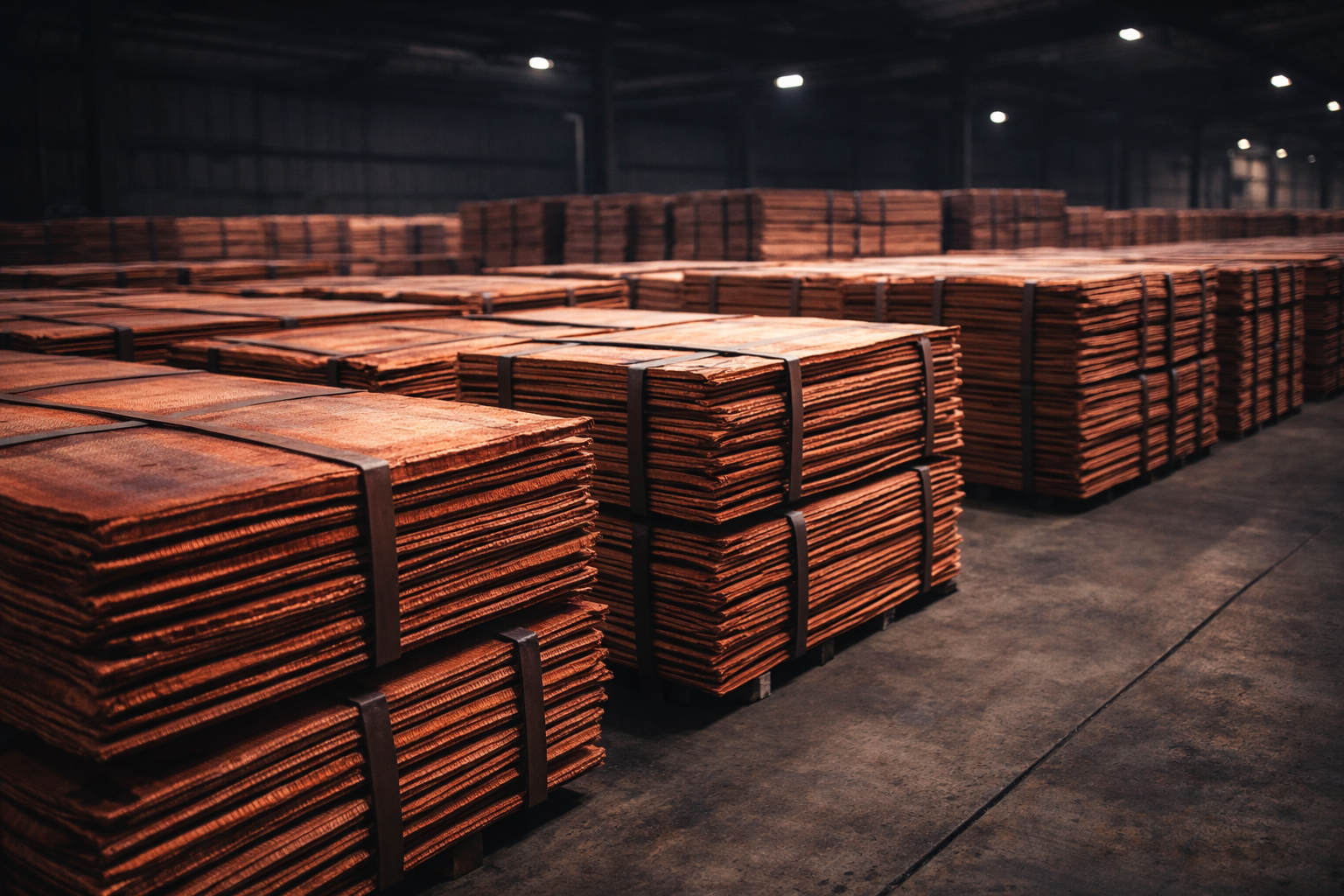
When institutions buy and sell physical copper through the LME, they are not trading ingots, wire, or scrap. They are trading copper cathodes: flat, high-purity copper sheets produced through electrolytic refining to achieve a purity of 99.99% or better.
Cathodes are the starting point for manufacturing. They are melted down and drawn into wire, rolled into sheet, or alloyed for industrial applications. Every EV motor, wind turbine, solar panel, and data centre ultimately traces back to copper cathodes moving through this supply chain. The standardised format makes them stackable, transportable, and straightforward to audit.
To be traded on the LME, cathodes must meet strict specifications and come from an LME-registered brand. This is what "LME Grade A" means in practice: a specific purity and quality standard that every counterparty in the market can rely on.
"Copper is not just a financial asset. It is a strategic industrial resource, and the physical market reflects that reality in ways a price chart never can."
C4CU Research Team
What Is a Copper Warehouse Warrant?
The warehouse warrant is the instrument that makes the physical copper market function. A warrant is a legal document representing ownership of a specific, identifiable quantity of copper stored in a specific LME-approved warehouse. It is not a futures contract, a claim on an index, or a share in a fund. It represents actual metal in a named location.
The standard unit represented by a single warrant is approximately 25 metric tonnes of copper. When an institution buys a copper warrant, it holds documented title to that tonnage. The warrant can be held as an asset, transferred to another party, or cancelled when the owner takes physical delivery of the metal.
LME warrant data is published daily. The number of warrants in the system is a key market indicator: falling warehouse stocks tighten the physical market and can push the spot price into steep backwardation, where prompt delivery commands a premium over future-dated contracts. In 2022, LME copper warehouse stocks fell by roughly 80%, illustrating precisely how quickly physical tightness can develop.
Where Is the Copper Stored?
LME-approved warehouses are distributed across multiple continents to serve regional industrial demand. Key locations include Rotterdam (Netherlands), Singapore, South Korea, Malaysia, and the United States. Each facility must meet the LME's operational and security standards to maintain its approval status.
These warehouses serve three functions simultaneously. They are storage facilities, holding physical metal until it is needed in manufacturing. They are delivery points, where a seller can deposit metal and a buyer can withdraw it. And they are market supply indicators: the aggregate inventory across the LME network gives traders a live read on physical availability, which directly influences the spot price.
When a buyer holds a warrant and takes physical delivery, they arrange for the metal to be released from the warehouse and transported to their facility. The entire chain, from warrant issuance to physical withdrawal, is documented and auditable.
Physical Copper vs Paper Exposure: What You Actually Own
The distinction between owning physical copper and holding a paper instrument that tracks its price is not a minor technicality. It determines what you actually hold, what risks you carry, and what happens when the physical market tightens.
| Feature | Physical Copper (LME Grade A) | Copper ETF / Futures |
|---|---|---|
| What you own | Allocated metal in a named warehouse | A financial instrument, typically futures contracts |
| Counterparty risk | None: the metal exists independently | Issuer and exchange counterparty risk |
| Rehypothecation | Not possible with allocated metal | ETF assets can be lent out |
| Tracking accuracy | Directly linked to LME spot price | Roll costs and contango can cause 5-15% annual tracking error (S&P Global) |
| Physical delivery | Yes, available on request | No: cash settled or rolled |
| Minimum size | 25 tonnes (LME warrant); smaller via C4CU | Any amount via brokerage |
Why Retail Access Has Been Almost Impossible
The physical copper market has been effectively closed to individual buyers for three reasons: minimum size, logistics, and infrastructure. A single LME warrant represents roughly 25 tonnes of copper. At current prices, that is a seven-figure entry ticket before you factor in storage, insurance, and specialist knowledge of the delivery process.
As a result, retail investors wanting copper exposure have been pushed toward mining stocks, futures-backed ETFs, or leveraged products. Each of those routes introduces layers of financial intermediation between the buyer and the metal. The ETF holds futures, not cathodes. The mining stock reflects a company's operational performance, not the spot price alone. The futures contract carries roll costs that compound silently over time.
The physical market, with its warehouse warrants and allocated ownership, has remained the domain of institutions, commodity traders, and industrial manufacturers. That gap is what platforms like C4CU are designed to close: providing access to LME-grade copper cathodes in smaller allocations, with professional storage and insurance already built in.
The LME warrant system is not a technicality for traders to learn. It is the foundational mechanism through which physical copper supply is tracked, transferred, and priced globally. When warehouse stocks fall, prices rise. When warrants are abundant, the market softens. Anyone seeking genuine exposure to copper as a commodity needs to understand this system, because it is what drives the underlying asset they are trying to hold.
Why Understanding the Physical Market Matters Now
Copper demand is structurally growing. The IEA projects global copper demand to double by 2035, driven by electrification, EV adoption, renewable energy buildout, and AI data centre infrastructure. A single EV requires roughly 83 kg of copper, four times the amount in a conventional vehicle. One AI data centre consumes as much copper as 30,000 homes (IEA, 2024).
On the supply side, the pipeline is constrained. The average time to develop a new copper mine is 15 to 20 years. Mining grades have declined by roughly 25% over the past two decades. Chile and Peru, which together account for around 40% of global supply, face ongoing challenges around water availability and social licence (USGS, 2024).
That structural backdrop is visible in the physical market before it fully registers in price charts. Falling warehouse warrants, rising spot premiums, and tightening LME stocks are often the earliest indicators of a supply squeeze. Investors who understand how the physical market works can read those signals. Those who only watch ETF prices cannot.
Frequently Asked Questions
Q: What is a copper warehouse warrant and how does it work?
A copper warehouse warrant is a legal document representing ownership of a specific quantity of physical copper stored in an LME-approved warehouse. Each warrant typically covers approximately 25 metric tonnes. The holder has documented title to that metal and can hold it, transfer it to another party, or cancel the warrant to take physical delivery. Warrant data is published daily by the LME, making it a live indicator of global physical copper availability.
Q: How is the copper price determined on the LME?
The LME copper price is set through open-market trading between registered members, reflecting global supply and demand in real time. It is denominated in US dollars per metric tonne and serves as the benchmark used by mining companies, manufacturers, and commodity traders worldwide. Physical warehouse inventory levels are one of the most direct influences on spot pricing: when LME copper stocks fell by roughly 80% in 2022, it reflected genuine tightness in the physical market, not just financial positioning.
Q: What is LME Grade A copper and why does the grade matter?
LME Grade A is the internationally recognised quality standard for traded copper cathodes: a minimum purity of 99.99% produced through electrolytic refining. The grade matters because it is the only form the LME accepts for delivery against its contracts. It ensures every tonne traded to that standard is interchangeable with every other tonne, making the market liquid and pricing reliable. Lower grades or unregistered brands trade at discounts and cannot be delivered into the LME system.
Q: Does a copper ETF actually own physical copper?
Most copper ETFs do not hold physical metal. They hold futures contracts, which must be rolled forward periodically at a cost. In contango markets, where future prices exceed spot, this roll cost can erode returns by 5 to 15% per year relative to the spot price (S&P Global). Additionally, ETF assets can be subject to rehypothecation, meaning they may be lent out to other parties. A physical copper warrant, by contrast, represents allocated metal in a specific warehouse that cannot be lent or re-used without the owner's consent.
Q: Is physical copper liquid enough to sell quickly if I need to exit?
The LME copper market trades approximately $15 trillion in metals annually, making it one of the most liquid commodity markets in the world. Physical copper held in LME-approved warehouses can be sold by transferring the underlying warrant to a buyer. At retail scale, liquidity depends on the platform through which the metal was purchased: C4CU facilitates principal-to-principal transactions, meaning metal can be sold back or on-sold subject to market conditions. Liquidity for smaller allocations is not instantaneous in the way a stock trade would be, and the price of copper is volatile and can go down as well as up.
Q: How can I own physical copper without storing 25 tonnes myself?
Historically the 25-tonne minimum of an LME warrant put physical copper out of reach for individual buyers. C4CU was built to close that gap. The platform provides access to LME Grade A copper cathodes in smaller allocations starting from 10 kg, with the metal stored in a professional, insured facility. Ownership is allocated in your name, meaning your copper is identifiable and segregated, not pooled. You gain direct exposure to the physical commodity without needing a warehouse of your own.
Ready to Own Physical Copper?
Start with as little as 10 kg of LME Grade A copper cathode: stored, insured, and allocated in your name.
Start Owning Copper →
Get Copper Market Updates
Join investors receiving insights on copper prices, market trends, and opportunities. Free, no spam.
By subscribing, you agree to our Privacy Policy.
Ready to Own Real Copper?
Start owning physical copper today. Simple, transparent, accessible.