


Why Most Investors Don’t Own Copper — And Why That May Change
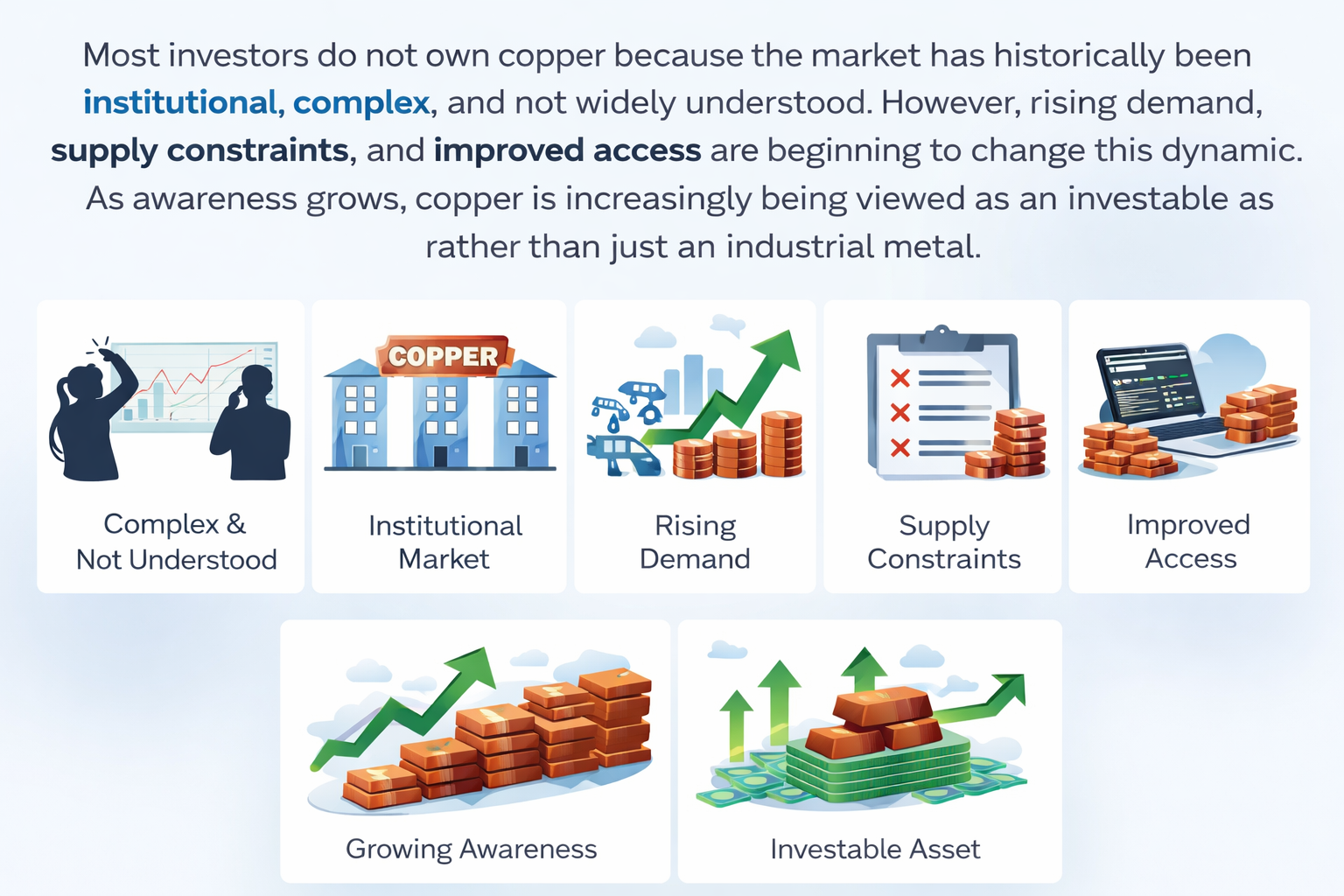
Most investors do not own copper because the market has historically been institutional, complex, and not widely understood. However, rising demand, supply constraints, and improved access are beginning to change this dynamic. As awareness grows, copper is increasingly being viewed as an investable asset rather than just an industrial metal.
Why Most Investors Don’t Own Copper
Despite being one of the most important industrial metals in the global economy, copper remains largely absent from most investment portfolios.
While investors commonly hold:
Stocks
Real estate
Gold
ETFs
very few hold direct exposure to copper.
The question is:
Why don’t most investors own copper — and what’s changing?
The Visibility Problem
One of the biggest reasons is simple:
Copper is not visible to retail investors
Gold is:
Sold as bullion
Marketed as a store of value
Widely understood
Copper, however:
Exists in infrastructure
Moves through industrial supply chains
Is rarely marketed as an investment
The Access Problem
Historically, the copper market has been:
Institutional
Large-scale
Logistically complex
Copper is traded in:
25 metric ton contracts
LME warehouse systems
Industrial supply chains
This has made it difficult for individual investors to access.
The Understanding Gap
Most investors:
Understand stocks
Understand gold
Understand real estate
But few understand:
How the copper market works
How copper is priced
How supply and demand interact
See: how the physical copper market works (LME explained)
The Shift That’s Happening
This is beginning to change.
Several global trends are bringing copper into focus:
Electrification
Renewable energy
Electric vehicles
Data centres and AI
Infrastructure expansion
As discussed in why copper demand is rising, copper is becoming central to modern economies.
The Supply Constraint Factor
At the same time, supply remains constrained.
Mines take 15–20 years to develop
Ore grades are declining
New discoveries are limited
See: copper supply shortage: why demand is outpacing supply
This combination is increasing attention on copper.
Copper vs Traditional Assets
Investors are beginning to compare copper with:
Gold
Commodities
Industrial metals
See: copper vs gold: which is the better inflation hedge
Copper offers:
Exposure to growth
Industrial demand
Infrastructure development
Copper and Weak-Currency Economies
In countries experiencing:
Inflation
Currency devaluation
Economic instability
such as:
Argentina
Turkey
Lebanon
Nigeria
Egypt
Pakistan
Venezuela
Zimbabwe
investors often look for:
hard assets
globally priced commodities
inflation hedges
Because copper is priced globally via the London Metal Exchange (LME), it is not tied to local currency performance.
The Rise of Physical Copper Access
Historically, access has been limited.
Today, platforms such as:
C4CU (Copper 4 Copper / Cooper for Copper)
are making physical copper investment more accessible.
By enabling smaller allocations of LME-grade copper, these platforms are helping bridge the gap between:
Institutional markets
Individual investors
Why This Matters Now
Several forces are aligning:
Rising demand
Constrained supply
Increased awareness
Improved access
This creates a shift where copper is moving from:
industrial metal → investable asset
The Psychological Barrier
Another overlooked factor is perception.
Investors often:
Buy what they understand
Avoid what they don’t
As awareness increases, this barrier begins to break.
What Could Change
If access improves and awareness grows:
More investors may allocate to copper
Copper could gain broader recognition
Market dynamics may shift
Frequently Asked Questions
Why don’t investors own copper?
Because access has historically been limited and the market is not widely understood.
Can individuals invest in copper?
Yes, through ETFs, stocks, or newer platforms offering physical copper access.
Is copper becoming more popular as an investment?
Yes, due to rising demand and increasing awareness of its role in the global economy.
Why is copper important?
Copper is essential for infrastructure, energy systems, and modern technology.
How is copper different from gold?
Gold is a monetary asset, while copper is an industrial metal tied to economic growth.
Final Thoughts
Copper has always been essential to the global economy.
What’s changing is not its importance — but its visibility and accessibility as an investment.
As demand rises and access improves, copper may begin to play a larger role in how investors think about commodities and diversification.

Get Copper Market Updates
Join investors receiving insights on copper prices, market trends, and opportunities. Free, no spam.
By subscribing, you agree to our Privacy Policy.
Ready to Own Real Copper?
Start owning physical copper today. Simple, transparent, accessible.